Marriage as an economic arrangement
The House of Bernarda AlbaMarriage as an economic arrangement in The House of Bernarda Alba is most visibly embodied in Angustias’s engagement to Pepe el Romano, a match shaped by her inheritance and surrounded by her sisters’ suspicion that wealth, rather than love, has attracted him. The play makes marriage part of the household’s financial structure: inheritance determines which daughter is eligible to marry, class determines which suitors may be accepted, and prescribed domestic roles leave women with little power to shape the terms of their future.
Inheritance, Kinship, and Eligibility
Angustias occupies a distinct position in the family because she is the only daughter of Bernarda Alba’s first marriage. Her stepfather, Antonio María Benavides, leaves her substantially more money than he leaves his four natural daughters. That unequal inheritance makes her the household’s sole wealthy daughter and changes the meaning of her engagement: her sisters connect Pepe’s interest in her to the money she has received, while the play leaves open questions about why Antonio favored her so markedly. The inheritance thus operates not simply as background property but as a force that alters relationships among the daughters and gives Angustias a marriage prospect unavailable to them on equal terms.
The family’s divided kinship helps explain why this financial advantage produces resentment rather than uncomplicated celebration. Magdalena and Amelia regard Angustias’s wealth as the reason Pepe is pursuing her, and Magdalena contrasts the twenty-five-year-old, notably handsome suitor with Angustias, whom she considers the least appealing of the sisters. Their comments reveal how the engagement is assessed from outside the couple: the sisters weigh money, appearance, age, and opportunity, and suspect that the match is an exchange in which Angustias’s inheritance compensates for what they perceive as her lack of romantic appeal. The play presents this suspicion as a household interpretation, not as proof that Pepe has stated his motive.
Marriage within a Restricted Social Order
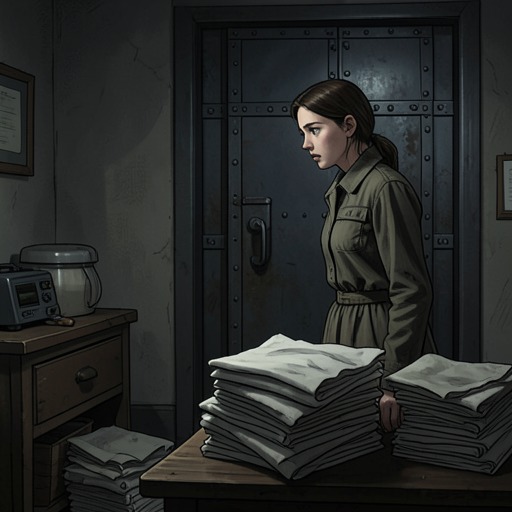
The engagement belongs to a rural society in which women’s lives are organized around domestic work and marriage. Bernarda’s daughters sew and embroider, and she tells them that the eight-year mourning period will be spent preparing trousseaus, including linen from a chest of twenty pieces. The order of activities is significant: the daughters are confined at home, their labor is directed toward a possible future marriage, and the preparation is controlled by their mother. Marriage appears as one of the few recognized destinations for a daughter, but the work of preparing for it does not give her control over whom she marries or what kind of relationship she enters.
The social background described in the play’s commentary makes this pattern broader than one family. Long mourning periods, the division between men and women, and women’s domestic roles are presented as features of village life; spinsterhood and arranged, loveless marriage are likewise described as real prospects. The harvesters’ seasonal arrival and the community’s pervasive gossip place the household within a close-knit social world in which marriages, inheritance disputes, and sexual reputations are subject to public scrutiny. Marriage is therefore both a private relationship and a public arrangement that can affect family standing.
The hierarchy also determines which matches Bernarda will permit. Poncia challenges her for having denied Martirio the chance to marry Enrique Humanes, asking why Bernarda sent word for him not to come to Martirio’s window on the very day he was expected. Bernarda answers that she would refuse the match again because Humanes’s father was a farmhand: she will not allow their families’ blood to mix. Her refusal makes class, rather than Martirio’s inclinations, decisive. The episode establishes a contrast with Angustias’s engagement: wealth gives Angustias access to a socially valuable marriage, while a suitor associated with a lower-status family is barred from Martirio.
Love, Money, and Unequal Knowledge
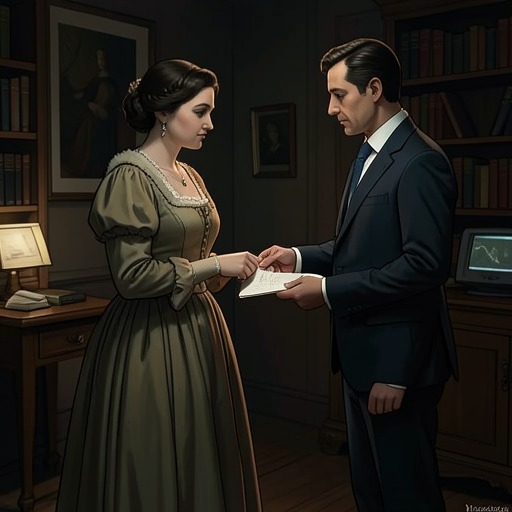
Angustias’s conversations with Bernarda show that economic advantage does not ensure emotional security. She tells her mother that Pepe seems distracted and speaks as if his mind is elsewhere; when she asks what is wrong, he replies that men have their problems. Angustias suspects he is hiding something and admits that she ought to be happy but is not. Her unease sits beside the outward facts of her engagement and inheritance: she has the money and the prospect of marriage, yet she lacks confidence that she understands her future husband’s feelings.
Bernarda’s advice does not encourage Angustias to seek clarity. She tells her to ask fewer questions after marriage, to speak when Pepe speaks, and to look at him when he looks at her; if she follows these rules, Bernarda says, they will avoid disagreements. She further warns Angustias not to discover what he is concealing and never to let him see her cry. This exchange frames marriage as an arrangement governed by female deference and male privacy. Angustias’s concern is answered not with a demand for mutual honesty but with instructions on how to accommodate a husband whose attention and thoughts remain his own.
That advice reflects the gender conventions Bernarda enforces throughout the household. The play’s commentary identifies her as an advocate of women’s subordination and domestic roles, and her prescriptions for Angustias carry those principles directly into married life. A daughter’s inheritance may make her attractive as a prospective bride, but it does not displace the expectation that she obey her husband. Economic eligibility and personal agency remain separate: money can secure a place in the marriage market without granting a woman equal authority within marriage.
Consequences and Thematic Significance
The household’s expenditure on appearances reinforces the material dimension of marriage. Bernarda says she spent sixteen thousand reales on furniture, and Prudencia is told that the wardrobe with a mirror is the finest piece. The purchase gives the wedding a visible economic scale: fine furnishings, inheritance, and a trousseau belong to the same world of resources and social display. The arrangement is not only about a couple; it also concerns what a family can provide and how its means are presented to others.
Yet the play repeatedly places the engagement beside evidence of a concealed emotional life. Martirio asks why Pepe is absent one night, and Bernarda says he has gone on a journey; Martirio’s pointed reaction suggests that his absence matters in the household beyond the official account. Later, Adela tells Martirio that Pepe came for Angustias’s money but that his eyes were always on her. This is Adela’s assertion during their confrontation, not a neutral confirmation of Pepe’s motives. Its force lies in the contrast it draws: the public engagement is attached to Angustias’s wealth, while Adela claims a private attachment between herself and Pepe.
The economic marriage plot is thus built from several kinds of unequal power at once. Antonio’s inheritance distinguishes a stepdaughter from his four natural daughters; Bernarda uses class to block Martirio’s proposed match; Pepe’s engagement to Angustias is read through her money; and Bernarda prepares her daughter for obedience rather than reciprocal negotiation. Marriage offers a route through which property and status may pass, but for the women it also reproduces the domestic hierarchy that restricts their choices. The tension between public suitability and private desire makes the engagement consequential well beyond its financial terms.